Google Ads vs. Practo/Pristyn Care: Which is Better for Private Clinic Growth?
The introduction of healthcare aggregators has transformed the landscape of how patients search physicians online. Many physicians have discovered too late that these platforms, including Practo, Pristyn Care, and Lybrate, have created a highly competitive environment and, thus, have turned medical services into a price comparison exercise.
Thus, many established physicians are exploring new clinic growth strategies that better provide direct access to patients rather than use third parties. Currently, there is considerable debate regarding Practo vs Google Ads for patient acquisition by physicians. Should doctors continue paying commissions and competing with dozens of other providers, or should they invest in building an independent patient acquisition system?
This guide compares both Practo and Google Ads for doctors as platforms for patient acquisition and should help you make an informed decision about which patient acquisition platform for doctors is most appropriate for your practice.
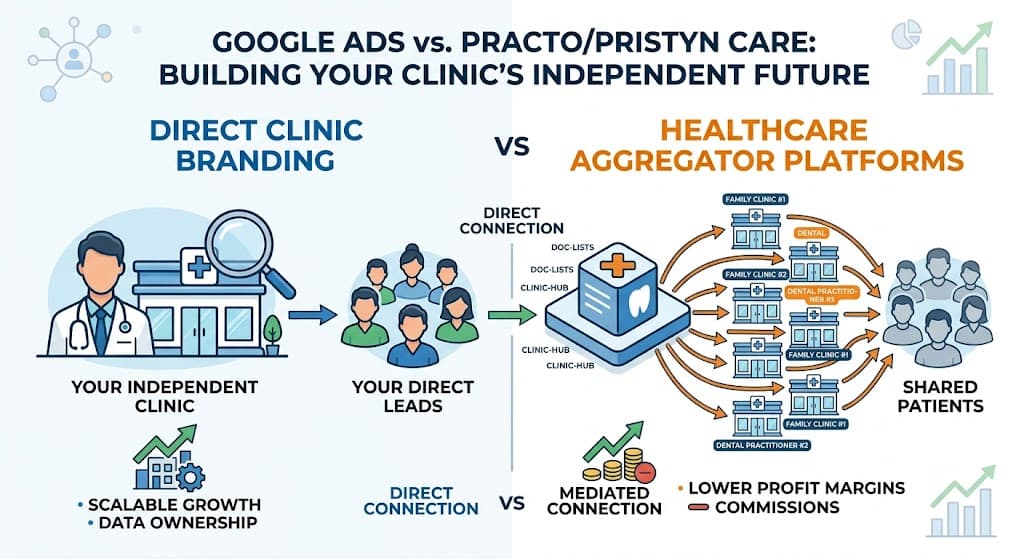
The Aggregator Model (Practo, Pristyn Care, Lybrate): Pros & Cons
Using healthcare aggregators is often a clinic’s first step into digital marketing. These platforms offer an easy patient acquisition method and assist in creating immediate online visibility.
Pros
Instant Visibility
Aggregators who developed themselves already have a strong online presence and significant brand recognition. Through an aggregator’s marketing system, doctors can present themselves and appear quickly to prospective patients searching for health care services.
No Technical Setup Required
Creating an account/profile on an aggregator is simple. They simplify daily workflows for busy healthcare professionals by managing doctor listings, automating appointment scheduling, and matching patients with the right specialists.
Faster Initial Patient Flow
More quickly than traditional methods, new clinics can generate requests for appointments since patients are already using these aggregators to search for healthcare providers.
Cons
High Commission Per Patient
Many online aggregator platforms collect either a commission, subscription, or premium listing fee. These additional costs can greatly reduce your profitability over time.
Competing With Multiple Doctors
Due to the number of physicians listed as part of the aggregate, you have a consistent competition when trying to differentiate yourself and prove your expertise.
Limited Brand Equity
When patients search for a physician online, they often only remember the platform as opposed to the name of the clinic or physician they visited. This means you’re helping build the platform’s brand more than your own.
Limited Ownership
The platform dominates in controlling your ranking, visibility, and how you connect with prospective patients. This means you have limited control over how they are presented to potential patients.
For larger medical setups, deploying optimized Google Ads for hospital growth secures higher search rankings and multi-specialty patient leads.
The Independent Model (Google Ads Services): Pros & Cons
Google Ads is a new way to do healthcare marketing in India and allows you to gain patients directly through your websites and landing pages.
Pros
Complete Ownership of Leads
All enquiries come directly from a patient to your clinic. There is no third-party communication with the patient.
Builds a Premium Brand
Google Ads allows you to showcase your credentials, services, and expertise on your custom website/landing page, strengthening your brand authority.
No Commissions
You do not have to pay any commissions for patient appointments coming through Google Ads. After a patient contacts the clinic, you solely own that relationship.
Better Patient Experience
Your patients prefer your clinic’s website over competing profiles, which guarantees a better, highly professional, and focused experience.
Long-Term Growth Potential
As your campaigns improve over time, your clinic can grow patient acquisition while establishing your brand and online presence through Google Ads.
Cons
Requires Advertising Budget
Constant investment is required to get a desired result.
Needs Professional Management
A successful Google Ads campaign requires precise keyword targeting, landing page optimisation, and ongoing performance monitoring. Without assistance, costs can rise too quickly.
Head-to-Head Comparison: Cost, Brand Control, and Long Term Value
| Factor | Aggregator Platforms | Google Ads Services |
| Initial Setup | Very Easy | Moderate |
| Cost Structure | Commission & listing fees | Advertising budget |
| Cost Per Lead | Variable | More Controllable |
| Brand Visibility | Platform focused | Clinic focused |
| Patient Ownership | Shared | Complete Ownership |
| Data Ownership | Limited | Full access |
| Patient Retention | Moderate | Higher |
| Brand Loyalty | Platform loyalty | Clinic Loyalty |
| Long Term Value | Moderate | High |
| Scalability | Limited | Excellent |
The Verdict: Which Platform Should You Choose?
The choice you make about how to market your practice will be influenced by the current stage of development your clinic is at. Newer practices or those just starting up may find aggregator sites extremely helpful to generate awareness for your business as well as receive enquiries from potential patients for the first time. An aggregator is the most straightforward solution for establishing an online presence quickly and easily.
On the other hand, established physicians who plan to grow their practice may find that using aggregation platforms as the primary source of referrals will be too costly to sustain and overly restrictive for the future. Due to high fees, increased competition, and minimal control of your business’ branding, the long term profitability will typically diminish.
In contrast, Google Ads allows doctors to create their own brand identity, develop their own marketing strategies, and bring new patients directly to the doctor’s office in a more sustainable manner than relying on aggregation.
Successful practices typically begin by utilizing aggregatorsinitially but then transition to independent marketing as they continue to build their practice.
Summary
Depending on your growth goals, your decision about a patient acquisition platform for doctors can vary greatly. Aggregators like Practo or Pristyn Care offer convenient access to potential patients and immediate exposure to your practice; they often have recurring costs and limited brand control.
When comparing Practo vs Google Ads, the biggest benefit to independent advertising is creating long-term sustainable advertising strategies. With Google Ads, clinics can establish themselves as trustworthy experts in their field, control their leads, and build a system for acquiring patients in a predictable manner. For those doctors looking for growth, you will likely benefit far more with independent advertising than through an aggregator.
Additionally, third party platforms force doctors to compete directly against peers, whereas independent advertising empowers physicians to uniquely position their practice. Take control of your practice’s growth with our premium Google Ads for Doctors setups and build a sustainable pipeline of high quality patients.
Read also: What is the Actual Cost of Google Ads for Doctors?
Frequently Ask Questions?
Google Ads is far better for high-ticket surgical patients because it targets active search intent. Unlike aggregators where patients price-shop among competitors, Google Ads sends traffic directly to your website.
Medical aggregators charge recurring subscriptions or commissions per patient, while Google Ads charges per click. Aggregators cost less upfront but limit profit margins as your clinic scales.
Yes, Google Ads has strict medical privacy policies, whereas aggregators handle compliance internally within standard templates. When running Google Ads independently, you must follow specific rules regarding medical phrasing.
Yes, a hybrid strategy works best for new clinics. Use aggregators for immediate patient flow at launch, then scale up Google Ads to build long-term independence.